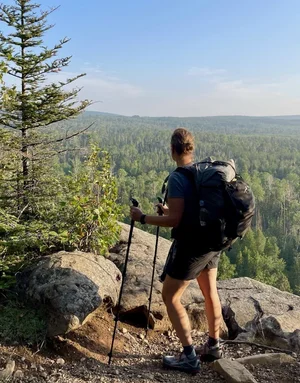
Grab some coffee or a cup of tea, turn off those distractions, and allow yourself some space to reflect on how these three lessons from nature could bring more connection and meaning to your life.
What was that? I wondered as I jolted awake during a restless night of sleep. It was my first night camping alone, and there are no words to describe how anxious I felt. Unable to fall back asleep, I crawled out of my tent to see what was causing all the ruckus and discovered that a gang of raccoons had stolen the empty garbage bag I had hanging nearby. Relieved that it wasn’t an axe murderer, I climbed back into my tent so I could toss and turn until the sun came up.
Since that night, nearly a decade ago, the outdoors has come to feel like home. I’ve become so comfortable camping alone that I’ve criss-crossed the United States hiking, camping, and exploring more than half a dozen times. I’ve spent weeks in the middle of nowhere on remote wilderness canoe trips and even completed a solo thru-hike, carrying everything I needed to survive on my back for 352 miles. I share these stories not to brag or prop myself up on some sort of outdoorsy pedestal, but to show you what’s possible when you commit to pursuing your passions—no matter where you’re starting from.

Sunset on Hawai’i’s North Shore
An unlikely adventure
How I got here is an unlikely adventure. I wasn’t exposed to these activities growing up, but when I discovered them later in life, it felt as though they had always been a part of me. Since I’ve shared these stories many times in other articles, I’ll keep it short.
With zero interest in hosting a big, extravagant, and expensive wedding, my husband and I opted to elope in Hawaiʻi. If you’ve had the good fortune of visiting this paradise, you already know it’s impossible to go there and not fall in love with nature’s abundant beauty. If I had to identify just one catalyst for the outdoorsy life we enjoy today, that trip would be it.
That experience prompted us to start exploring the great outdoors in our home state of Minnesota. The following summer, we visited Lake Superior’s North Shore and were instantly hooked. We drove more than three hours north every chance we got to hike and explore Minnesota’s rugged and breathtaking Arrowhead region.
Since we didn’t come from outdoorsy families, we were not yet campers. That meant all of these trips came with hefty lodging bills, and each year we shelled out thousands of dollars until we arrived at a crossroads that forced us to make a change.
In our early 30s, we decided we wanted to create a future that looked very different from the life we were currently living. We set some aggressive financial goals, went all in, and slashed everything from our budget that wasn’t necessary for our survival. We still wanted to get up north, though, so we decided to give camping a try. We weren’t necessarily excited about camping in and of itself—it was simply the most affordable way to travel and explore.
That’s when something unexpected happened.
We fell in love with it—like REALLY fell in love with it.
On each trip, we stretched the limits of our comfort zones and learned new and valuable outdoor skills. What I worried would be an uncomfortable and even miserable experience wasn’t uncomfortable at all. There was something about sleeping outdoors that felt like home. It felt safe. It felt like a place I’d always belonged.
It’s been more than two decades since we started exploring the great outdoors, and it has become an inextricable part of our lives. It’s changed everything about how we live. More importantly, it’s changed who we are and who we’re becoming. We’ve learned so much on this journey—not just outdoor survival skills, but priceless life lessons. Today, I want to share three of the most powerful lessons with you.
3 powerful life lessons learned in nature

Nature can show us all we need to know if we’re willing to slow down, pay attention, and listen.
3 — I need very little to be happy
“Everything I need to be happy and healthy fits into the back of my Subaru Outback,” I quipped in the caption beneath a photo I posted on Instagram. After that first restless outing where I was tormented by raccoons, I headed out on a three-week road trip to start tackling my goal of visiting every Minnesota state park.
This is an important reminder in an economic system where growth is directly tied to consumer spending—often beyond our means. I’ve heard it argued that keeping up with the Joneses is a biological drive that can be traced back to our caveman ancestors. He with the most jerky, dried berries, and hides was most likely to survive the winter, get the most viable mate, pass on his genes, and perpetuate our species.
In today’s always-on, Instagrammable world, fancy vacations, new cars, and the latest fashion have replaced hides and dried berries as our status symbols. We now have 24/7 access to purchasing these symbols, not just on websites like Amazon, but increasingly through social media apps that relentlessly remind us that who we are and what we have is not enough. Even more worrisome is the growing trend of buy now, pay later to acquire these status symbols. This comparative consumerism can be found everywhere. Unfortunately, it’s especially prevalent in the world of outdoor recreation.
If you’ve ever chased materialism—and let’s be honest, we all have at some point—you know that a more expensive mountain bike or canoe paddle won’t bring lasting happiness. Quality outdoor gear can offer years of joy and adventure when we use it well, but the shiny newness eventually wears off.
When I’m backpacking, canoe tripping, or even luxurious truck camping, I’m limited in how much I can bring with me. I’m constantly looking for gear that serves multiple purposes and finding ways to make do with what I already have.
This lesson has fused with how we live our daily lives. We buy as little as possible and use things until they literally fall apart. We appreciate what we have—not just the material things, but the small moments like quiet mornings and time in nature. These practices help us use our resources—our health, time, and money—more intentionally, live in better alignment with our values, and be more generous with others.
Make it actionable: live better with less
Practice gratitude. Take time each day to express thanks for the blessings in your life—people, experiences, nature, and even the air you breathe.
Before you buy, ask: “If no one else saw this, would I still want to purchase it?”
Pause before hitting the buy button. Leave items in your cart overnight. This simple habit can easily cut spending and give you time to take inventory of what you already have.

Morning perfection in the Blue Ridge Mountains of North Carolina.
2 — Everything (and everyone) is connected
Wow, I thought as I looked down at a decomposing log. Not long ago, I would have thought this was dead, but now I see that it’s teeming with life. Mosses, fungi, insects, and small mammals were all making use of this former shade-giving giant. It’s all inextricably connected, I realized as I turned to continue down the trail. And I’m part of it, too.
The connectedness we find in nature is awe-inspiring. Did you know that a stand of aspen trees is actually one organism? Its main life force is an extensive, intertwined underground root system, and each visible tree is a genetic replication of the others. The oldest known stand, called Pando, can be found in Utah’s Fishlake National Forest. It’s estimated to be over 80,000 years old and weighs around 6,600 tons. Even if every tree in the stand were wiped out, it would be difficult to permanently eradicate the root system because of how rapidly it reproduces.
Then there are the redwoods. These towering giants, which can grow as tall as a 35-story skyscraper and live up to 2,000 years, have surprisingly shallow roots. Their roots reach only 10 to 13 feet deep, but stretch outward as much as 80 feet. The interconnectedness of this root system contributes to their longevity, creating a massive support network that provides stability and resilience for the entire grove. Through a process called root grafting, they’re able to use these shallow roots to share water and nutrients with one another.
We, humans, aren’t much different. It may not always feel that way—especially as technology accelerates and our world grows more politically divided—but our lives are inextricably woven together. Try to think of anything in your life today that would have been possible without nature’s abundance and the hands of your fellow humans. As I stand here looking at the laptop I’m using to write these words, I find it unfathomable how many human lives were touched along its journey to my desk—not to mention the countless natural resources it contains that were extracted from all over the world.
It’s easy to feel like an island—especially as social media, AI, and other technologies speed up our lives and pull our attention in a thousand directions. But it’s undeniable that we need one another. We need nature, too. We always have, and we always will—likely even more as we move deeper into the AI revolution.
Make it actionable: reconnect with what matters
Put down your devices and go outside. Take ten minutes to sit in the grass, look up at the sky, or walk in a nearby park. Leave your phone at home or, at the very least, put it in airplane mode. Notice what feels alive and connected around you.
Talk to people instead of scrolling. Call someone instead of texting. Chat with the person behind you in line at the grocery store rather than picking up your phone. Get to know your neighbors. It can feel scary, but if you allow yourself to be vulnerable, you’ll be richly rewarded.
Reflect on the people who shaped your life. Take time this week to think or journal about the most impactful people who helped you get where you are today. Imagine how your life would be different had your paths not crossed. What gifts did they leave you with? Have you shared with them how their presence impacted you?

Sunrise over the Atlantic Ocean.
1 — Life is paradox
The ground felt unstable beneath our feet. I could sense something big was about to happen, and as we chatted with the national park staff, I could tell they felt it too.
Several years ago, my husband and I visited Hawaiʻi Volcanoes National Park just before a massive eruption of Kīlauea changed the island of Hawaiʻi forever. One afternoon, as we carefully hiked along the hardened lava near the summit of Mauna Loa, it hit me. These massive lava flows were not just destroying life and everything in their path—they were also creating life. The island was growing. Creation and destruction were happening simultaneously.
I imagine we’ve all had moments in our own lives when we experienced this undeniable truth. The perfect job or relationship imploded, and it felt like life was over. But looking back, we’re grateful it all fell apart so something new could come together.
Knowing this, it has become difficult for me to see any situation as strictly black and white. Everything we see and experience is filled with nuance. To take that even further, we’re all experiencing these nuances through wildly different lenses based on our unique life experiences.
Next time you’re tempted to hold your ground at all costs, remember that nature doesn’t operate in black and white, right and wrong, good guys and bad. So why should we? How might your life improve if you embraced duality?
Make it actionable: practice holding paradox
Recall a time when something you cared deeply about fell apart. What did you learn from that experience? What did the falling apart make possible?
Think about a time you were absolutely certain about something but changed your mind when new information became available. What did that teach you?
Consider something you have a very strong opinion about. Now bring to mind someone you know who sees it differently. Can you recognize any ways in which their belief might also hold some truth?
Nature as a wise teacher in an age of rapid technological advancement
Nature can show up as a wise and gentle teacher when we’re open to observing her lessons. These are just three of the most impactful lessons I’ve learned, but there are countless others we can draw on to create better alignment in our lives. In a world dominated by social media, AI, and constant disruption, returning to the natural world reminds us of what’s real: simplicity, connection, and paradox.
As always, I share these thoughts not as the only truth, but to inspire you to find your own. I hope these stories opened your eyes to what you might discover when you slow down, step outside, and pay attention to nature’s wisdom.
Want more? Subscribe to my Substack for my latest stories and photography. Then join my email newsletter for monthly inspiration, exclusive photos, and practical tips to live an adventurous and intentional life.